
Data Reconnaissance: Understanding your practice’s data landscape
Business, Medical Billing, Reporting & Analytics

Jonathan Retano
January 13, 2023
Disclaimer: This blog article was written by an AdvancedMD partner. The views and opinions expressed in this article are those of the author(s) and do not necessarily reflect the official policy or position of AdvancedMD.

In many situations in our lives, building a strong foundation is important. For example, you would not want to build your dream house on shaky ground. Similarly, you wouldn’t bet on your favorite football team without a strong offensive and defensive line. Lastly, you would not try to build a successful rock band without a great backing drumbeat and bass.
The point is, it’s crucial to set your foundation first. Similarly, when one dives into customized AdvancedMD reporting it is important to focus on data quality and data assurance first. Reviewing all the details of your CPT Codes, Facilities, Providers, etc. will go a long way in avoiding confusion as your reporting matures.
Introducing ‘Data Reconnaissance’
With this in mind, we coined the term ‘Data Reconnaissance,’ which basically means you need to understand your data landscape and exactly what data you have to work with before you can start analyzing it. Your data foundation should be set on the building blocks of data quality and data governance—before you start building out reports for your practice. Or, as my old math teacher used to say, “Always show your work.” At Pharmafusion, we have found a number of key data quality checks to ensure your foundation is solid.
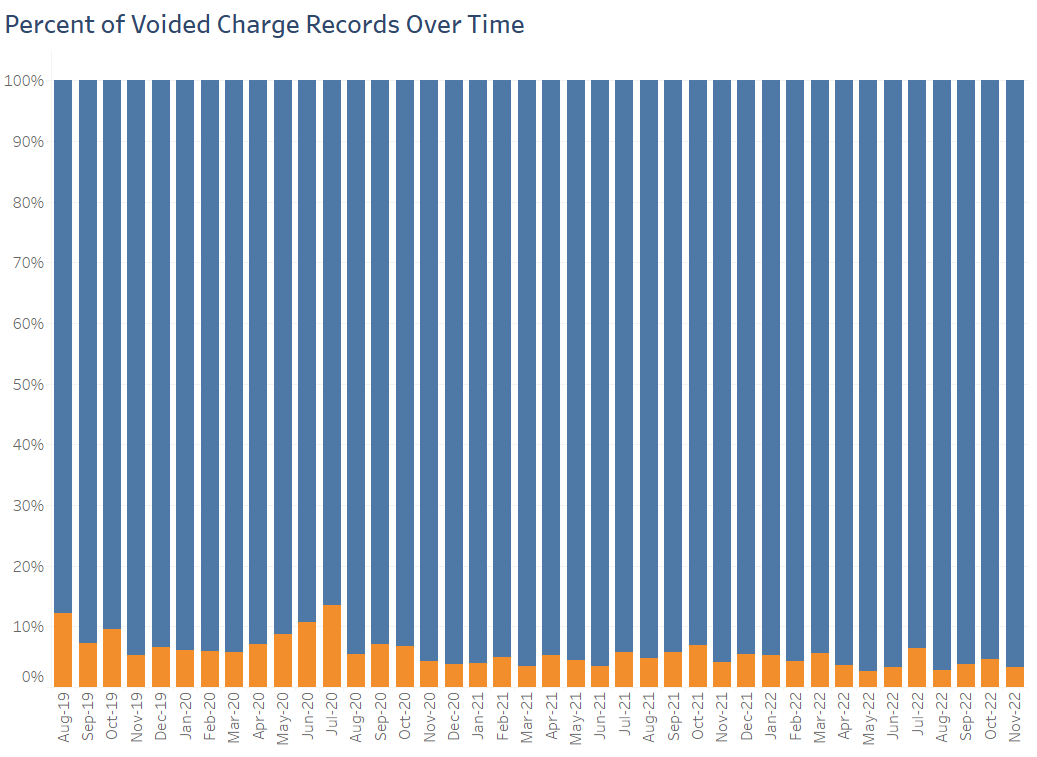
1. Graph the percent of voided charges over time – It is good to know how often charges are getting voided out. Also, it might highlight one particular provider or facility that has difficult entering charges correctly the first time. Also, look at if the trend of voided charges is getting better or worse.
2. Charge code bloat – Typically, not all of the thousands of charge codes in the master file are used by your practice. It is good to get a sense of what percentage of charge codes in the master file are actually utilized. A frequency distribution of the most common charge codes is helpful and important.
3. Charge codes are not CPTs – Often, users will use a kind of shorthand in the creation of new charge codes that do not match exactly to an official CPT code designation. For example, they may add a suffix letter on to the end of a charge code.
4. Single providers with multiple unique profiles – Another issue we see often is when, for legitimate or key stroke error reasons, a single provider may have multiple profiles. This is important to keep in mind when aggregating the total activity of a provider.
If you would like to learn more about our AdvancedMD analytics services or hear about our platform CPTFusion, please feel free to connect with Jonathan Retano at Pharmafusion. We love problem-solving and finding better ways to streamline your daily operations. You can also read more about Pharmafusion founder Jonathan Retano here.
Get a Free, Personal & Live Demo
Get an in-depth overview of AdvancedMD and our Amazon Web Services cloud platform to learn how automated and unified software can make life better for every role of your practice (patients included).
Request live demo