
The Quality Payment Program: What Matters Most for Your Practice
MIPS and quality reporting, regulations

AdvancedMD Staff
November 17, 2026
If you see Medicare patients, you have probably heard of the Quality Payment Program (QPP), the Merit-based Incentive Payment System (MIPS) or both. Much of the available guidance is written for compliance specialists. This guide focuses on what matters most for your practice and what to do first.
What is the QPP, and where does MIPS fit?
The QPP is Medicare’s framework for paying clinicians based on the quality and cost of care rather than volume alone. It has two tracks: Advanced Alternative Payment Models (Advanced APMs) and MIPS. Some independent practices fall under MIPS, which adjusts your Medicare Part B payments based on a score from 0 to 100. According to AdvancedMD’s QPP overview, for the performance period that score combines four categories:
- Quality (30%): how you perform on clinical quality measures over a full year
- Cost (30%): calculated by the Centers for Medicare & Medicaid Services (CMS) from your claims, with nothing for you to submit
- Promoting Interoperability (25%): how you use certified electronic health record (EHR) technology, tracked over at least 180 consecutive days
- Improvement Activities (15%): care improvement activities completed over at least 90 consecutive days
Five things worth knowing
1. It may apply to you, even if it never has
MIPS covers more than physicians. Eligible clinician types include physicians, nurse practitioners, physician assistants, physical and occupational therapists, clinical psychologists, and several others. Whether you are required to report depends on volume, not specialty. For 2026, you generally must exceed all three low-volume thresholds. There are more than $90,000 in Medicare Part B allowed charges, more than 200 Part B patients and more than 200 covered professional services.
Eligibility is determined for each clinician at each practice. That means a doctor who works at two practices can be required to report at one and be exempt at the other.
2. MIPS scores affect your Medicare payments
Clinicians who score below the performance threshold can face a negative adjustment of up to 9% on Medicare Part B payments. Higher scorers can earn a bonus. For the performance period, a score of 75 or higher avoids a penalty and may earn a bonus. Adjustments are applied two years after the performance period, so the work you do in 2027 affects your payments in 2029.
3. Most of the work happens during the year, not after it
Quality measures are tracked patient-by-patient across a full 12 months, and the other categories need 90 to 180 days of activity. Practices that wait until the year is over may find gaps in their data, with little time to correct them. Practices that start in January have already lost time to pick measures, confirm data is flowing from their charts and fix problems.
4. Specialists have a new model to watch
On Jan. 1, 2027, CMS launches the Ambulatory Specialty Model (ASM), a mandatory model for certain specialists in selected regions. According to the American College of Surgeons, the model includes cardiologists for heart failure. For low back pain, it includes anesthesiology, pain management, interventional pain management, neurosurgery, orthopedic surgery, and physical medicine and rehabilitation. Clinicians in ASM are exempt from MIPS reporting while they participate in the model.
Participation depends on more than specialty. Clinicians must also practice in a selected region and have at least 20 attributed episodes, according to Becker’s ASC Review. Attributed episodes are cases of the targeted condition that CMS assigns to a clinician. The publication also reports that downside risk grows over time, reaching as much as 12% by the final year of the model. If you are in one of these specialties, CMS’s ASM page is the place to see whether you are on the participant list.
5. The rules keep changing
CMS’s final rule for calendar year 2027 continues the shift toward MIPS Value Pathways (MVPs), which are reporting tracks built around a specialty or condition. The rule ends the traditional MIPS reporting option after the 2030 performance period. Beginning in 2031, MVPs will be the only MIPS reporting option for clinicians who do not participate in a MIPS alternative payment model (MIPS APM). Clinicians in a MIPS APM can still report through the APM Performance Pathway (APP).
The rule also adds three MVPs, for a total of 30, starting with the 2027 performance period: Diabetic Disease, Hospitalist and Hypertension.
Other finalized changes that affect planning for 2027 and 2028 include:
- A new MIPS core measure requirement in the quality category, which replaces the outcome or high-priority measure requirement for the 2027 performance period.
- Removal of the Security Risk Analysis measure from the Promoting Interoperability category for the 2027 performance period.
- The Electronic Prior Authorization measure, which is an optional bonus measure in 2027 and becomes required in 2028.
- A new Electronic Prior Authorization for Prescription Drugs measure, required beginning in 2028.
How to check your status with your National Provider Identifier (NPI)
CMS provides a free lookup tool, which is a practical first step.
- Go to the CMS Participation Lookup.
- Enter your 10-digit individual NPI. CMS says the tool shows your QPP participation status by performance year.
- Review the most recent year listed. If you work at more than one practice, each appears separately.
- Read your result. You will see whether you are required to report, eligible to opt in or not required. The tool also lists special statuses, such as small practice, rural, hospital-based or non-patient-facing, which can reduce what you need to report. For example, small practices (15 or fewer clinicians) don’t have to report the new MIPS core measure required starting in 2027. They are also automatically exempt from the Promoting Interoperability category. They can still choose to submit Promoting Interoperability data, but if they do, CMS scores that category instead of exempting it, so submit only if your data is strong.
To check eligibility for your whole practice, sign in to the QPP site. According to the CMS eligibility page, you can view practice-wide eligibility there.
CMS is clear that the lookup is a technical resource and does not officially determine anyone’s status. If your result is unclear, confirm it with a MIPS specialist.
What your result means
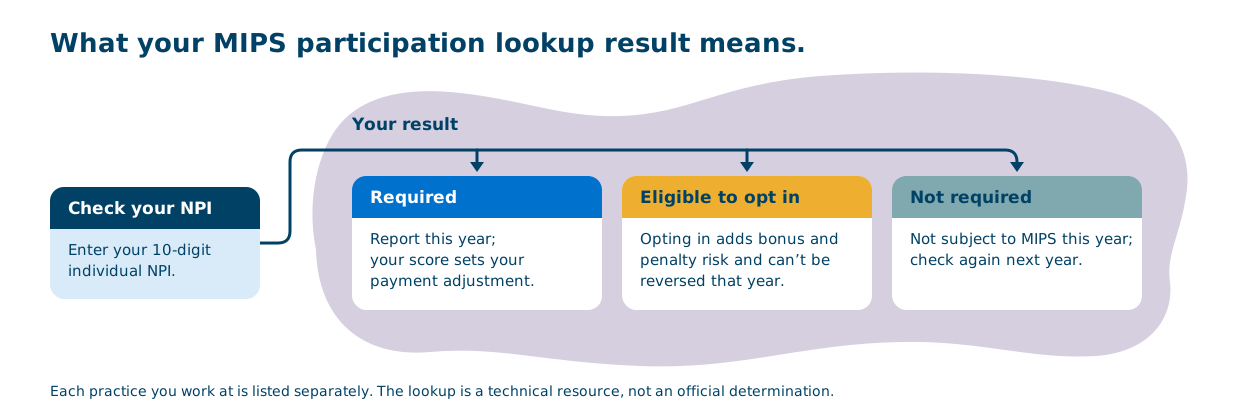
- “Required.” You need to report for that performance year and will receive a payment adjustment based on your score. Start planning now.
- “Eligible to opt in.” You fall short on at least one volume threshold. You can choose to participate and become eligible for a bonus. Opting in also exposes you to a penalty, and the decision cannot be reversed for that year.
- “Not required.” You are not subject to MIPS for that year. Check again each year, because your status can change as your Medicare volume changes.
What to do first
- Check your NPI using the CMS lookup above.
- Know your answer for each practice you bill under.
- If you are required, set up before the year starts. Pick your measures, confirm the data is flowing from your charts and decide who is accountable for tracking your score.
- Don’t overlook deadlines. The QPP site lists exception applications, including for extreme and uncontrollable circumstances, open through Dec. 31, 2026.
Frequently asked questions
Does MIPS apply to specialists?
Yes. Eligibility is based on Medicare billing and patient volume, not specialty. Some specialists may instead be placed in the Ambulatory Specialty Model starting in 2027.
What happens if I don’t report?
If you are required and do not report, you can receive the maximum negative adjustment, currently up to 9% of Medicare Part B payments.
Can I be required at one practice but not another?
Yes. CMS determines eligibility for each combination of clinician and practice.
Is the CMS lookup official?
It is a free CMS tool, but CMS describes it as a technical resource rather than a formal determination.
When should I start?
Start as early as possible. Quality data is collected across the full year, so late starters have less to work with.
How AdvancedMD Population Health helps
AdvancedMD Population Health is built for practices already on AdvancedMD, so MIPS tracking happens in the system your team uses every day. Here is what it does:
- Shows where you stand, all year. A dashboard shows your MIPS Quality score and progress, by clinician and for the group. You can track your progress before the year ends.
- Helps you choose and track measures. You can see the quality measures available to you, track your performance on the ones you pick, and get recommendations on where to improve.
- Submits to CMS for you. AdvancedMD Population Health is a qualified registry, so your data is submitted to CMS on your behalf.
- Gives you a team, not just software. Check-ins with MIPS specialists help flag issues early, while there is still time to fix them.
- Goes beyond MIPS if you need it. The same tool supports other value-based programs, such as the Medicare Shared Savings Program (MSSP) and the Accountable Care Organization (ACO) Realizing Equity, Access, and Community Health (REACH) Model.
Talk to our team about MIPS reporting with AdvancedMD Population Health.
Get a Free, Personal & Live Demo
Get an in-depth overview of AdvancedMD and our Amazon Web Services cloud platform to learn how automated and unified software can make life better for every role of your practice (patients included).
Request live demo