
What is a Healthcare Clearinghouse?
Billers, Claims, Integrations

AdvancedMD Staff
November 10, 2026
A practice can send claims on time and still see payments arrive late. Denied claims accumulate in work queues, and billing staff spend time on calls with payers to learn why. In many cases, the cause is an error that could have been caught before submission.
What is a healthcare clearinghouse? It is an intermediary between healthcare providers and payers that checks, formats and sends claims so payers can process them. This article explains how clearinghouses work, why they matter and what to look for when choosing one.
Healthcare clearinghouse definition
The short answer to “What is a healthcare clearinghouse?” is a third-party service that turns billing data into standardized electronic transactions payers can process. A medical billing clearinghouse receives claims from the practice management system and checks them for errors. It then sends each claim to the right payer in a format that the payer accepts.
Clearinghouses also have formal standing under the Health Insurance Portability and Accountability Act (HIPAA). HIPAA names three types of covered entities: health plans, healthcare providers that conduct certain transactions electronically and healthcare clearinghouses. As covered entities, clearinghouses must follow HIPAA privacy and security requirements. That matters because claims contain patient health information, and the clearinghouse is directly accountable under federal law for protecting it.
One way to picture the role: The clearinghouse works as a translator and a quality inspector. It translates practice data into the format each payer reads, and it inspects each claim before the claim leaves.
The claim journey through a clearinghouse
Following one claim from start to finish shows what a healthcare clearinghouse does at each step.
- Claim creation: Staff create the claim in the practice management or billing system, using charge, coding and patient data from the visit.
- Scrubbing: The clearinghouse checks the claim for errors such as missing fields, invalid codes or mismatched patient data. Claims scrubbing reduces errors before the payer sees the claim.
- Formatting: The clearinghouse converts the claim to the American National Standards Institute (ANSI) X12 837 format, the HIPAA standard for electronic claims.
- Transmission: The clearinghouse routes the claim to the correct payer using its payer ID, a code that identifies the payer in electronic transactions.
- Response handling: The clearinghouse returns acknowledgments, rejections and remittance data to the practice.
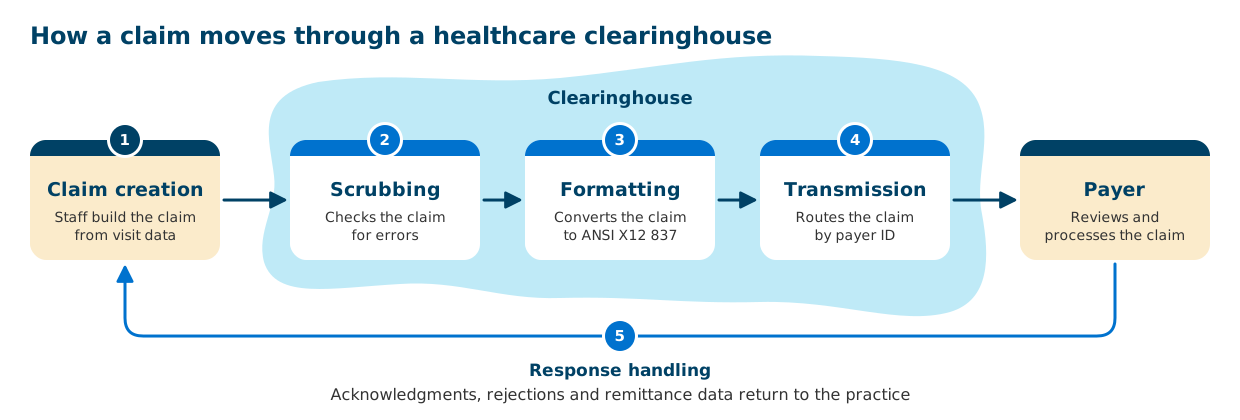
Because the clearinghouse automates these checks, claims processing tends to be more consistent from one claim to the next.
Key transactions a clearinghouse handles
Healthcare clearinghouse services extend beyond claims. Each transaction that passes through the clearinghouse, including eligibility requests and status inquiries, uses a numbered HIPAA standard format.
- Eligibility and benefits verification (270/271): The practice sends an inquiry (270), and the payer returns a response (271) with coverage and benefit details. Front-office staff use this to confirm coverage before or at check-in.
- Claims submission (837P and 837I): The 837P is for professional claims from physicians and other clinicians. The 837I is for institutional claims, such as those from hospitals. Accurate submission is the starting point for timely payment.
- Electronic remittance advice (835): Electronic remittance advices explain how the payer processed each claim, including payments and adjustments. Many practice management systems use 835 data to post payments automatically, which reduces manual entry.
- Claim status inquiries (276/277): Billing staff can check claim status (276) and receive the payer’s answer (277) without calling the payer.
Benefits of using a healthcare clearinghouse
For many practices, a healthcare clearinghouse supports both cash flow and daily workload. Common benefits include:
- Higher clean claim rates and fewer denials: A clean claim is one the payer can process without corrections. Catching errors before submission improves claim accuracy.
- Faster reimbursement: Claims that pass scrubbing generally move through payer review with fewer delays, which supports steadier cash flow.
- One connection to many payers: Staff submit through a single connection instead of logging in to separate payer portals.
- Less manual work: Automated checks, status updates and payment posting can lower administrative costs.
- Better visibility: Claim tracking, reporting and analytics show where each claim stands and where problems recur.
- Support for HIPAA compliance: Standard formats and secure transmission help protect patient data.
Clearinghouse rejections vs. payer denials
Rejections and denials both stop payment, but they happen at different points and need different fixes.
A rejection from a healthcare clearinghouse means the claim never reached the payer. The clearinghouse found formatting or data errors and returned the claim to the practice. A payer denial means the payer received and processed the claim but refused payment, for reasons such as eligibility, medical necessity or missing authorization.
The difference matters for workflow. A rejected claim can generally be corrected and resubmitted quickly, because the payer has not reviewed it yet. A denied claim typically requires a corrected claim or an appeal, which takes more time and staff effort. Tracking claim rejections separately from denials helps billing teams fix each problem at its source.
Common rejection reasons include:
- Patient demographic errors, such as a misspelled name or an incorrect date of birth
- An invalid National Provider Identifier (NPI), the unique 10-digit number assigned to a healthcare provider
- Coding mismatches, such as diagnosis and procedure codes that are invalid or inconsistent
Standalone vs. integrated clearinghouses
Practices generally connect to a healthcare clearinghouse in one of two ways.
A standalone clearinghouse is a separate vendor. Using one may mean extra logins, manual file uploads and data handoffs between systems. Some practices choose this setup so they can keep the same clearinghouse if they change software.
An integrated clearinghouse is built into the electronic health record (EHR) or practice management system. Claims flow from the visit to the payer without re-entry.
Weigh these trade-offs when comparing the two:
- Workflow efficiency: Integration reduces steps and switching between systems.
- Error risk: Each manual handoff is another chance for data entry errors.
- Cost structure: Standalone clearinghouses are typically priced separately, while integrated options may be bundled with software.
- Support: An integrated setup may mean one support contact instead of two vendors.
Criteria for choosing a clearinghouse
Many clearinghouses offer similar core services, so compare the details. Review these criteria when evaluating a healthcare clearinghouse:
- Payer network and enrollment support: Confirm the clearinghouse connects to your payers and helps with enrollment. Enrollment is the setup required before you can exchange electronic transactions with a payer.
- Scrubbing quality: Ask how scrubbing works and whether it includes payer-specific rule edits.
- Real-time eligibility: Real-time eligibility checks let front-office staff confirm coverage before the visit.
- Reporting and denial management: Look for claim tracking, rejection reports and tools to manage denials.
- Pricing model: Compare per-claim fees, monthly flat fees and bundled pricing against your claim volume.
- Integration: Confirm how the clearinghouse connects to your EHR and practice management software.
- Customer support and implementation: Ask what training and setup help is included.
- Security: Review security certifications and how the vendor supports HIPAA compliance.
AdvancedMD and integrated clearinghouses
A healthcare clearinghouse can send only the information a practice provides. If a practice misses a patient’s active coverage, the balance may be billed to the patient or written off. If payers are billed in the wrong order, a well-formatted claim can still be underpaid or denied.
AdvancedMD offers integration with both Change Healthcare and Waystar, as well as several add-on services that benefit users of these clearinghouses. For example, AdvancedMD clients who use Waystar as their clearinghouse can add Waystar Coverage Detection. This tool helps practices find coverage they did not know about, including:
- Active insurance on accounts treated as self-pay
- Missed secondary and tertiary payers
Coverage results, including active or inactive status, payer order and effective dates, appear in the patient’s record in AdvancedMD practice management software. Because the checks run in the background, front-desk staff spend less time on manual lookups. The goal is to correct coverage details before the claim goes out, not after it comes back denied for a coordination of benefits (COB) error.
AdvancedMD also offers add-on modules for related tasks. Three are available to clients of either clearinghouse:
- EOB Conversion: Converts paper explanations of benefits (EOBs) to electronic remittances.
- Claim Attachments: Sends supplemental documents with healthcare claims.
- Prior Authorization: Automates prior authorization requests, reducing manual phone calls and faxes. This can reduce claim denials and speed up reimbursement.
Clients who use Waystar as their clearinghouse can also add:
- Denial & Appeals Manager: Helps manage denials and claim appeals, and builds appeal forms.
- Patient Estimation: Estimates patient costs.
- Analytics: Tracks, measures and helps improve financial performance with cloud-based business intelligence tools.
- Remit & Deposit Management: Matches payments to bank deposits.
Frequently asked questions
Is a clearinghouse required to submit claims?
HIPAA does not require practices to use a healthcare clearinghouse. It does require electronic claims to follow standard formats, and a clearinghouse is a common way to meet that requirement.
Can a practice submit claims directly to payers?
Yes, some payers accept claims directly. However, submitting claims to each payer separately means managing a separate connection, enrollment and set of requirements for each one.
How much does a clearinghouse cost?
Pricing varies by vendor and claim volume. Common models include per-claim fees, monthly flat fees and pricing bundled with practice management software.
How long does clearinghouse processing take?
Timing depends on claim volume, the payer and whether the claim needs correction.
Are clearinghouses HIPAA covered entities?
Yes. Healthcare clearinghouses are one of three types of HIPAA covered entities, along with health plans and healthcare providers that conduct certain transactions electronically.
The clearinghouse’s role in the revenue cycle
In practical terms, what is a healthcare clearinghouse? It is a critical link in the revenue cycle. It catches errors before claims reach payers, keeps transactions in standard formats and returns the information billing teams need to follow up. For many practices, that protects cash flow and reduces administrative work.
Learn how AdvancedMD can help your practice recover revenue and get paid faster.
Get a Free, Personal & Live Demo
Get an in-depth overview of AdvancedMD and our Amazon Web Services cloud platform to learn how automated and unified software can make life better for every role of your practice (patients included).
Request live demo