
What is Medical Billing? A Guide for Medical Practices
Claims, Medical Billing, Practice Administrators

AdvancedMD Staff
November 24, 2026
Medical billing turns patient visits into clean claims and tracks them until payment is posted to the practice’s account. Administrators, office managers and billing leads coordinate each step to keep cash flow predictable. This guide explains how a claim moves from visit to payment and what the terms on a payer’s paperwork mean. It also covers where billing goes wrong and how practices staff the work.
Key takeaways
- Medical billing turns a patient visit into a claim and follows that claim until the payer and the patient have paid.
- A claim moves through registration, coding, scrubbing, clearinghouse submission, adjudication and payment posting, and each step has an owner.
- Medical coding assigns the codes, while medical billing builds them into a claim and follows it to payment. Revenue cycle management covers the full financial cycle.
- Billing setbacks often trace back to registration mistakes, coding and documentation mismatches, missed filing deadlines or unworked denials.
- Practices can bill in-house, use a billing company or outsource revenue cycle management, depending on staffing, claim volume and how much control they want to keep.
What is medical billing?
Medical billing is the process of creating a claim for a patient visit, submitting it to the patient’s insurance payer and following up until the practice is paid. Any balance not covered by the payer is billed to the patient. Medical billing is one part of revenue cycle management (RCM).
Who handles medical billing
Practices handle medical billing in one of three ways:
- An in-house biller or billing team employed by the practice
- A medical billing company that submits claims and works denials for the practice
- The practice itself, often an office manager or physician owner at a small practice
Billing staff cannot work in isolation. They depend on the front desk for clean patient data, providers for clinical notes and coders for the correct procedure values.
How the medical billing process works
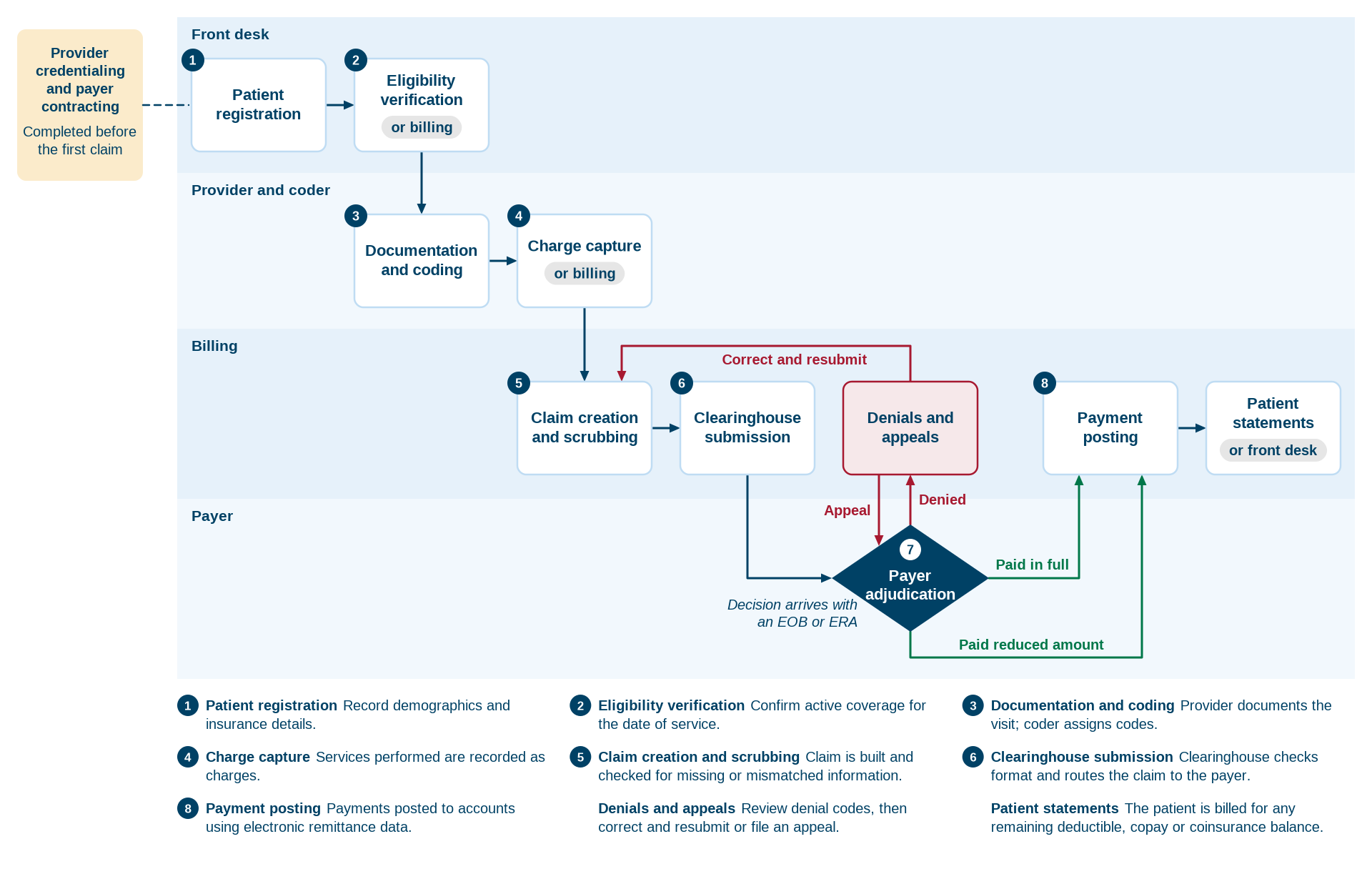
Day to day, medical billing moves claims through a structured workflow, with an owner assigned to each handoff. Before the first claim, the practice typically completes provider credentialing and contracting with each payer it bills.
| Step | What happens | Who owns it |
| Patient registration | Staff record demographics and insurance details | Front desk |
| Eligibility verification | Staff confirm active coverage through eligibility verification | Front desk or billing |
| Documentation and coding | The provider documents the visit, and a coder assigns codes | Provider and coder |
| Charge capture | Services performed are recorded as charges | Provider or billing |
| Claim creation and scrubbing | The claim is built and checked for missing or mismatched information | Billing |
| Clearinghouse submission | A clearinghouse checks the format and routes the claim | Billing |
| Payer adjudication | The payer pays, reduces or denies the claim | Payer |
| Payment posting | Payments are posted to accounts using electronic remittance data | Billing |
| Denials and appeals | Staff review denial codes, then correct, resubmit or appeal | Billing |
| Patient statements | The patient is billed for any remaining balance | Billing or front desk |
Before the claim: Registration, eligibility and coding
The claim starts before the patient arrives. At registration, the front desk records the patient’s demographics and insurance details. An eligibility check then confirms that coverage is active for the date of service. Electronic eligibility checks can confirm coverage before the visit if the entered insurance information is correct.
During the visit, the provider documents the care. A coder, or the provider at some practices, assigns codes from that documentation. These initial steps set the foundation for the entire claim. Typos at check-in or missing chart notes can delay payment.
Building and submitting the claim
After the visit, the services performed are recorded as charges. Billing staff create the claim from those charges and the assigned codes. Claim scrubbing then checks the claim for missing or mismatched information, such as a diagnosis code that does not support the procedure billed.
The claim then goes to a clearinghouse, which checks its format and routes it to the correct payer. Claim scrubbing and clearinghouse edits can catch formatting mistakes before the payer reviews the claim, reducing the number of claims returned for correction.
After the payer decides: Payment, denials and patient balances
The payer reviews the claim in a step called adjudication. They then pay the claim in full, pay a reduced amount or deny it. The decision arrives with an explanation of benefits (EOB) or an electronic remittance advice (ERA), which lists what was paid and why.
Three tasks follow:
- Post the payment: Apply payer payments to the patient account, using automated remittance posting where available.
- Manage denials: Review why the claim was denied, update the necessary details and resubmit or file an appeal.
- Bill the patient: Send statements for any remaining deductible, copay or coinsurance balance.
Reporting on unpaid claims shows the billing team which accounts need follow-up.
Related: Medical Billing Software for Small Practices: Navigating Reimbursement Challenges
Medical billing vs. medical coding vs. revenue cycle management
People often group medical billing and coding into a single phrase, yet they serve distinct functions. Coders assign standardized codes to patient records, while billers assemble those codes into claims and pursue reimbursement. Revenue cycle management covers the whole financial cycle, including decisions about whether to outsource billing.
| Function | What it covers | Typical owner | Main output |
| Medical coding | Translating documentation into standard codes | Certified coder or provider | Coded visit |
| Medical billing | Creating, submitting and following up on claims | Biller or billing company | Submitted and resolved claim |
| Revenue cycle management | The full financial cycle, from scheduling to collections | Practice leadership or an RCM partner | Collected revenue |
Medical billing terms to know
Claims, payer paperwork and patient statements share a common vocabulary. The glossary below defines the medical billing terms practice staff see most often.
Claim and payment terms
- Accounts receivable (A/R): money owed to the practice for services already provided.
- Allowed amount: the maximum a payer will pay for a covered service under the plan or contract.
- Claim: the request for payment a practice sends to a payer after a visit.
- Clearinghouse: a service that checks claims for formatting problems and routes them to payers.
- Denial: a payer’s decision not to pay a claim, with a reason code explaining why.
- Electronic remittance advice (ERA): the electronic file a payer sends to explain a payment, which the practice uses to post it to patient accounts.
- Explanation of benefits (EOB): the payer’s statement of what it paid and why, often sent to the patient.
- Payer: the insurance company or government program that pays the claim.
- Superbill: an itemized form listing the services, codes and charges for a visit.
Patient cost and code set terms
- Coinsurance: the percentage of a covered service’s cost the patient pays after meeting the deductible.
- Copay: a fixed amount the patient pays for a visit or service, often at check-in.
- Deductible: the amount a patient pays for covered care each year before the plan begins to pay for most services.
Claims also use three standard code sets. The coder assigns these codes, and the biller makes sure they appear correctly on the claim:
- Current Procedural Terminology (CPT): codes for procedures and services.
- International Classification of Diseases, Tenth Revision, Clinical Modification (ICD-10-CM): codes for diagnoses.
- Healthcare Common Procedure Coding System (HCPCS): codes for supplies, equipment and some services outside CPT.
Where medical billing goes wrong
Billing setbacks often trace back to one of four points:
- Registration mistakes: an incorrect insurance ID or outdated coverage on file.
- Coding and documentation mismatches: codes on the claim that the documentation does not support.
- Missed filing deadlines: claims submitted after the payer’s timely filing limit.
- Unworked denials: denied claims that are never corrected, resubmitted or appealed.
Staff time is part of the picture. In a June 2024 online survey of 266 AdvancedMD customers, about 65% of respondents said three or fewer employees manage their medical billing. The most cited payer challenge was appealing denied claims, and collecting balances owed by patients was the most cited patient-side challenge.
In-house billing, a billing company or outsourced RCM
Practices staff billing in one of three ways. The choice depends on staffing, claim volume, how much control the practice wants to keep and the cost structure it prefers.
In-house billing
Running billing in-house gives the practice full oversight of claims, payer calls and accounts receivable. However, maintaining internal teams requires ongoing software and payroll expenses, and staff turnover can delay claim submission and follow-up.
A medical billing company
A medical billing company submits claims and works denials for the practice. The practice typically keeps registration, eligibility checks and coding in-house and sends the billing company the information it needs. Billing companies often charge a percentage of collections or a fee per claim.
The practice gives up some day-to-day control, and it remains responsible for the accuracy of the information it sends. Practices comparing billing companies can ask how denials are reported and how soon claims are submitted after each visit.
Outsourced revenue cycle management
Outsourced revenue cycle management covers more of the financial cycle. An outsourced RCM team works alongside the practice on claim submission, denial follow-up, patient collections and reporting. Practices often consider it when the billing team is stretched, receivables are aging or denials are rising.
The trade-offs resemble those of a billing company: a different cost structure and less direct control. AdvancedMD RCM services work with the practice’s own staff, from claim submission through collections.
Conclusion
A reliable billing process requires clean registration up front, accurate coding and consistent denial follow-up. To identify the practice’s biggest bottlenecks, evaluate where claims stall: at check-in, coding, clearinghouse submission or final collection.
Frequently asked questions
What does medical billing do?
Medical billing makes sure a practice is paid for the care it provides. Billing staff submit claims to payers, follow each claim until it is paid or resolved and bill patients for any remaining balance. Claims that are not followed up can remain unpaid in accounts receivable.
Does a provider need to be credentialed before billing insurance?
In most cases, yes. Credentialing verifies a provider’s licenses, training and work history, and contracting sets the terms under which a payer reimburses the provider. Claims for a provider who is not yet enrolled with a payer can be denied, so practices adding a provider typically start early. The difference between the two steps is covered in credentialing vs. contracting.
What does medical billing cost a practice?
Medical billing costs depend on claim volume and how the practice staffs the work. Common cost drivers include:
- Staff time for billing, follow-up and patient collections
- Billing software subscriptions
- Clearinghouse fees, when they are not included in the software
- A percentage of collections or a per-claim fee for billing services
Costs vary by practice size and setup.
Get a Free, Personal & Live Demo
Get an in-depth overview of AdvancedMD and our Amazon Web Services cloud platform to learn how automated and unified software can make life better for every role of your practice (patients included).
Request live demo